Player outlook
Colston Loveland's rookie season changed in November. His price hasn't caught up.
Loveland jumped from 7.5 PPR points per game early to 12.5 late, and Ball Ranks puts him at TE5 despite Cole Kmet remaining in Chicago.

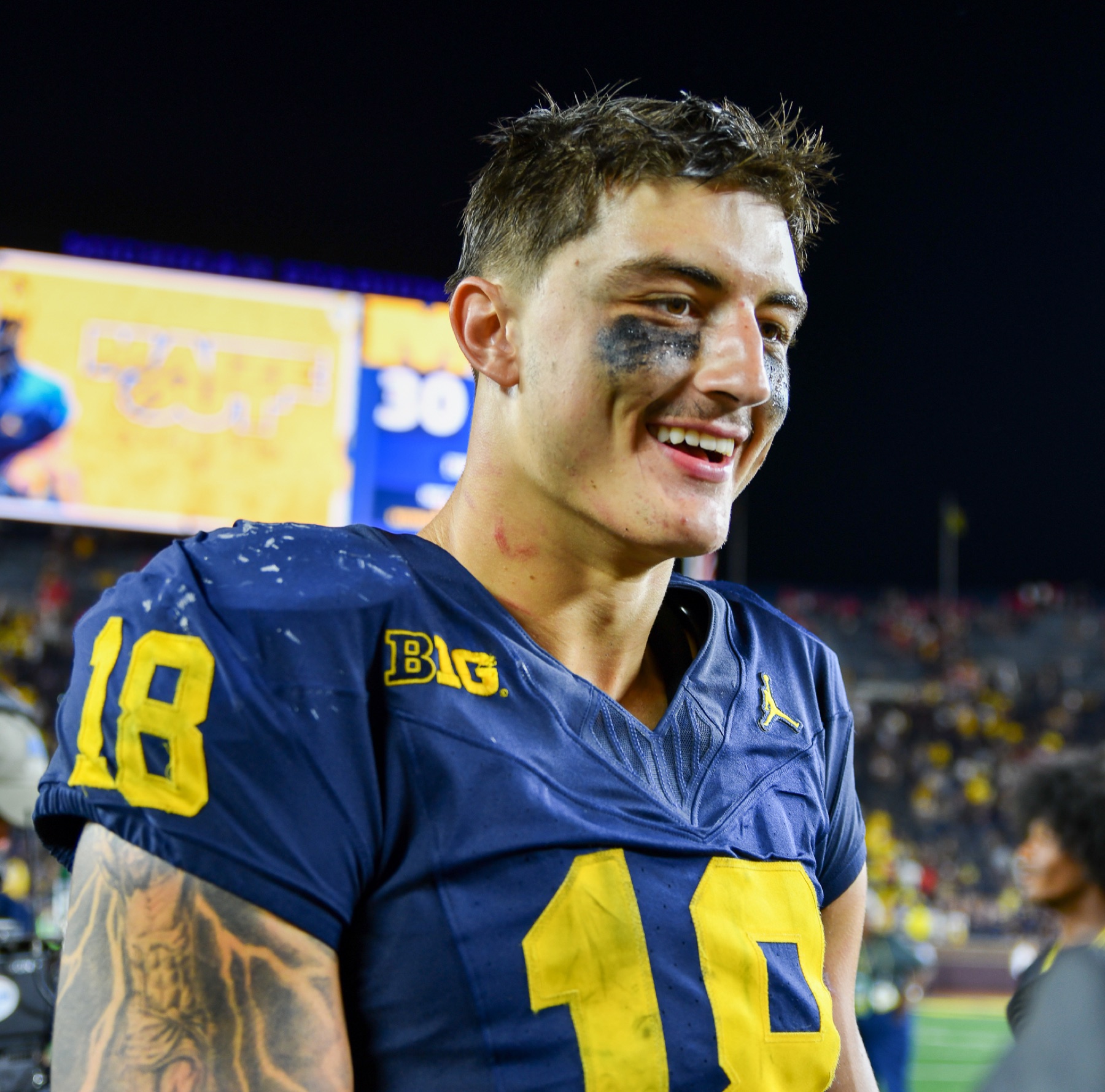
Colston Loveland's rookie stat line says 58 catches, 713 yards, and six touchdowns. Useful numbers. They also flatten the most important part of his season.
In his first seven games, Loveland averaged 7.5 PPR points. Over his final nine, he averaged 12.5. He closed with 46.5 points in two weeks, on 23 targets, 16 catches, 185 yards, and two touchdowns. This was not a rookie tight end producing at one steady level. It was a slow start followed by a five-month argument for a bigger role.
Ball Ranks projects 167.1 PPR points and puts Loveland 42nd overall, TE5. His ADP is 54.9. That 13-pick gap is a real edge without being a screaming bargain. The late-season performance is the main upside case.
The early-season drag had an explanation
Loveland entered the NFL as the 10th pick in the 2025 draft, then missed the entire offseason program while recovering from shoulder surgery. Chicago's 2026 tight end preview says he averaged 1.8 catches and 19.3 yards across six September and October games before averaging 4.9 catches and 65.8 yards over his final 12 games, including the playoffs.
That matters because rookie tight ends already face a difficult transition. Loveland had to learn Ben Johnson's offense without spring practices, share a room with an established starter, and regain trust in a repaired shoulder. By November, those obstacles were no longer shaping his weekly production in the same way.
His breakout was not one lucky Sunday. The 118-yard, two-touchdown game in Cincinnati announced it, but Loveland kept producing: five regular-season games above 10 PPR points after Week 9, then eight catches for 137 yards in Chicago's wild-card win. A postseason game does not count in fantasy totals. It does show that the offense continued treating him like a central receiver after the fantasy season ended.
A full offseason gives Chicago room to expand the job
The Bears are describing more than ordinary year-two comfort. Ben Johnson said during minicamp that the team had taken Loveland's route tree to the next level. In August, Chicago reported that Loveland was learning every receiving position and had remained one of Caleb Williams' most trusted targets. Team reports are naturally optimistic, but the details line up with what happened on the field late in 2025.
Camp usage has supported the same story. Williams found Loveland for red-zone touchdowns in practices on August 18, August 20, and August 26. Those are practice results, not points to add to a projection. They matter because six rookie touchdowns already established that the end zone can be part of his role.
The offensive structure is stable where it counts. Johnson remains the head coach and play caller, while Caleb Williams returns at quarterback. Press Taylor is the new coordinator after serving as Chicago's passing-game coordinator, so this is continuity with a title change rather than a new system erasing last year's progress.
Cole Kmet is still here, but the order has flipped
Chicago did not clear the tight end room for Loveland. Cole Kmet remains a capable receiver and blocker, and the Bears frequently use more than one tight end. Rookie third-round pick Sam Roush adds another option. The depth matters because Loveland needs routes and targets, not merely a place in the formation.
Colston Loveland's depth chart
CHI at TE, using ESPN's published depth chart.
| # | Player | 2025 snap shareAverage share of offensive snaps in the games he played, 2025 regular season. Green = entrenched, amber = rotational, gray = fringe. Check GP: a backup can post a real share in mop-up games while barely playing all season. | GPGames he appeared in, 2025 regular season — the denominator behind the snap share | 2025 finish2025 fantasy finish at the position (PPR) | 2026 projModel One's projected 2026 rank at the position (PPR) | ADPAverage draft position in real drafts this week — whether the market is drafting him at all is its own threat signal |
|---|---|---|---|---|---|---|
| 1 | Colston Loveland | 65%Snap share is averaged over the games he actually played (16). | 16 | TE12 | TE5 | 54.0 |
| 2 | Cole Kmet | 71%Snap share is averaged over the games he actually played (16). | 16 | TE36 | TE36 | undrafted |
Snap share and finish are 2025; projections and ADP are 2026 (Model One, PPR). "Undrafted" means no ADP in real drafts this week.
The important change is that Loveland now sits first and Kmet second. Last year began with the veteran protecting the rookie's transition; this year begins with the offense identifying Loveland as the more dangerous receiving option. Kmet can stay useful without blocking a top-five tight end finish, especially when his blocking lets Chicago move Loveland into the slot or outside.
There is still a ceiling on the target math. Rome Odunze and Luther Burden III command wide-receiver work, D'Andre Swift catches passes out of the backfield, and Kmet will not disappear. DJ Moore's move to Buffalo helps—he leaves behind 101 targets from 2025—but those opportunities will be divided across the offense. Loveland does not need all of them. He needs his late-season share to hold.
PPR is where the projection makes the strongest case
Loveland ranks TE5 in PPR and TE4 in half-PPR and standard, but his overall value moves more than the label. He is 42nd in PPR, 47th in half-PPR, and 48th in standard. That six-pick spread is the difference between drafting a high-volume receiver and drafting a touchdown-dependent tight end.
His 58 rookie catches created a solid base, and the late-season target totals point higher. In PPR, every short reception pays before the yards arrive. In standard, Loveland has to keep scoring to justify the same early pick. Managers should not use one universal price across formats just because the tight end label barely moves.
Ball Ranks' simple schedule calculation has Chicago's 2026 opponents allowing 212.5 passing yards per game last season, the second-toughest passing draw in the league, with a Week 10 bye. That backward-looking measure cannot account for every defensive change, but it makes the schedule a reason for caution.
The market may already price in the finish
Loveland is not a sleeper hiding in double-digit rounds. TE5 and an ADP around pick 55 ask you to spend a fifth-round pick on a second-year player with one NFL season. The market has watched the same November breakout and playoff performance.
Ball Ranks could still be too cautious. Model Zero projects 185.7 PPR points, 18.6 more than Model One. If the full offseason and Moore's departure turn Loveland into Williams' second target behind Odunze, even the higher number may be conservative. Young tight ends with first-round draft capital rarely combine this much late-season production with a clearer role the following year.
The miss can go the other way. Kmet remains good enough to take snaps, Chicago has several credible receivers, and a difficult passing schedule could make weekly volume uneven. Drafting Loveland at his ceiling would turn a promising breakout into a requirement.
Buy the second-half role
Take Loveland in the middle of round five in PPR when the elite tight ends are gone and you want access to the next tier before it becomes obvious. In standard leagues, wait longer; catches are a larger part of this bet than the tight end label suggests.
Follow his live projection on Colston Loveland's player profile, then compare the opportunity cost on the complete 2026 board. The rookie year started slowly. Your 2026 projection should not.
Sources and data notes
- Ball Ranks board, model projections, ranks, and ADP: September 4, 2026 snapshot. Player history, depth chart, team changes, and schedule calculation: August 29, 2026 snapshot.
- Chicago Bears tight end preview: Loveland's rookie splits, playoff production, and the current tight end room.
- Chicago Bears: his expanded route work and second-year development.
- Chicago Bears joint-practice report: a reported red-zone connection with Caleb Williams.
- Chicago Bears practice report: Loveland and Kmet working with the first-team offense.