Player outlook
DK Metcalf led the Steelers in targets. The yards never followed.
Metcalf was Pittsburgh's most-targeted receiver in 2025 yet finished with a career-low 850 receiving yards. Now Michael Pittman Jr. arrives to contest the volume that kept his season afloat.

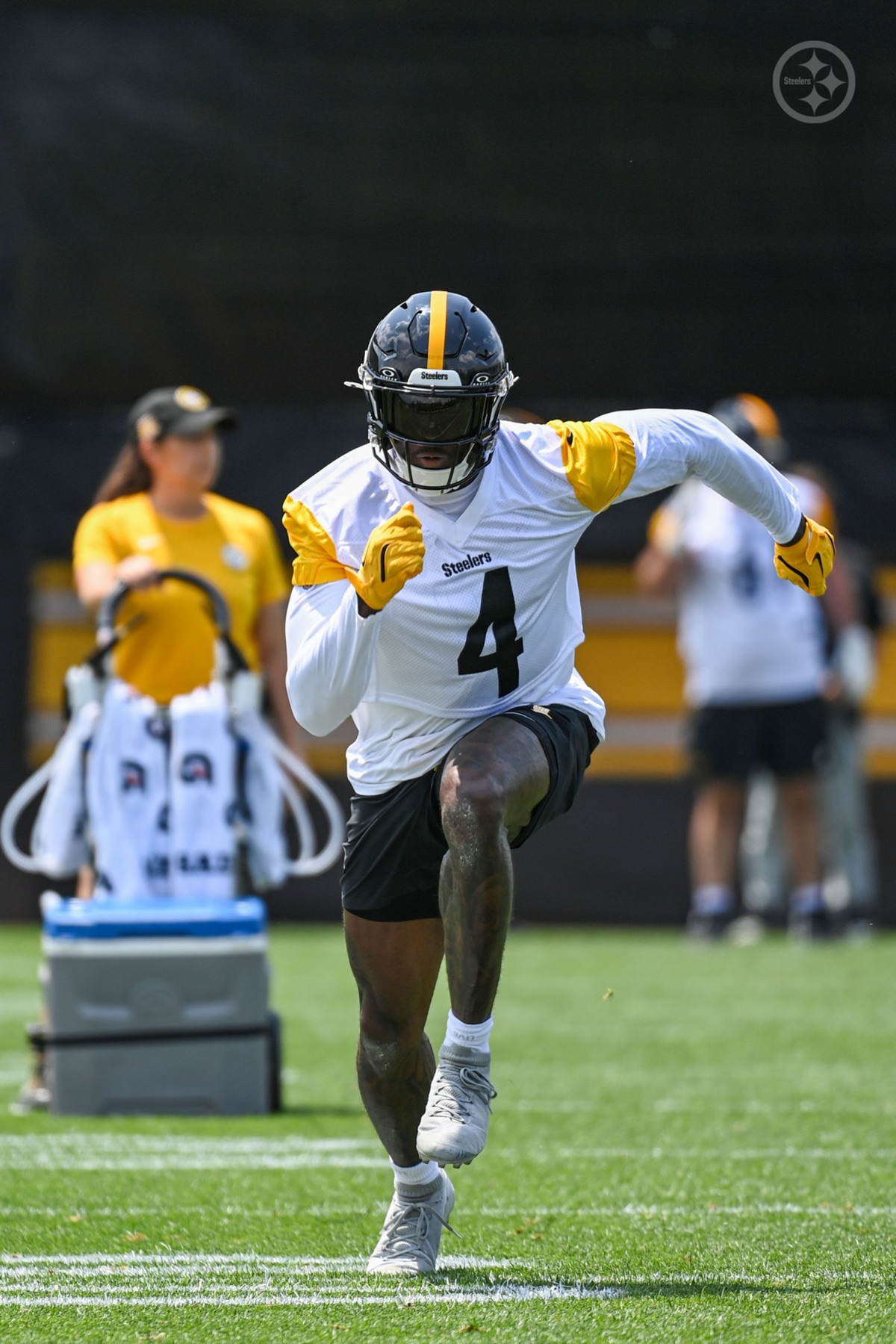
DK Metcalf's first season with the Pittsburgh Steelers produced a peculiar stat line: 99 targets, 59 receptions, 850 receiving yards, and six touchdowns. He led the Steelers in targets. He also finished with the lowest full-season receiving total of his career — on an offense that won the AFC North.
That discrepancy is the story. Metcalf was the first read as often as any Steelers receiver. He just did not turn the volume into the yardage the team paid for when it sent Seattle a second-round pick and gave him $150 million over five years.
Ball Ranks ranks Metcalf 59th overall and WR28 in PPR for 2026, projecting 186.1 points. That is close enough to his 64.8 ADP that his price feels fair — until you notice that the market is betting on him to hold his target lead and rediscover his old efficiency in a receiver room that just added real competition.
DK Metcalf's ranking trend
Lower rank is better. The final point is Ball Ranks' current projection.
Full data
| Season | Rank |
|---|---|
| 2019 | #129 |
| 2020 | #28 |
| 2021 | #53 |
| 2022 | #58 |
| 2023 | #57 |
| 2024 | #89 |
| 2025 | #70 |
| 2026 proj | #65 |
The yards-per-target math that separates WR2 from WR3
Metcalf was targeted 99 times in 2025, a workload that would anchor most receiver rooms. He converted that into 850 receiving yards — 8.6 yards per target and 57 yards a game across his 15 appearances. For a receiver whose game is built on contested catches and chunk plays, that is a WR3 stat line wearing a WR1 workload.
The quarterback was not the excuse. Aaron Rodgers threw for 3,322 yards and 24 touchdowns in his first Pittsburgh season and steered the team to a division title. Metcalf simply settled into a possession-heavy version of his game: six touchdowns kept the PPR total respectable at 187.2 points, but the explosive plays that once made him a weekly matchup problem showed up less often.
The question for 2026 is whether that was the new offense finding its shape or the new shape of Metcalf. Rodgers is back on a one-year deal at 42, now under Mike McCarthy, his old Green Bay head coach, after Mike Tomlin stepped down in January. Continuity at quarterback cuts in Metcalf's favor. The age of that quarterback does not.
Veteran age and the efficiency cliff
Metcalf was born in December 1997. He will turn 29 before the 2026 season ends. That age itself is not a career ender; receivers peak late, and 28-29 is when many settle into their most consistent, experience-heavy usage patterns. Yet it is also the phase in which efficiency sometimes stalls, and 2025 was already his quietest yardage season.
The ceiling is still substantial: hold the 99 targets and lift the per-target yardage back toward double digits, and Metcalf clears 1,100 yards and lands in the low-WR2 range. The floor — fewer targets in a deeper receiver room at the same efficiency — is a borderline-WR3 outcome.
The new competition for his targets
The bigger 2026 change is not the quarterback — it is the receiver across from him. Pittsburgh traded for Michael Pittman Jr. in March and signed him to a three-year deal. Pittman drew 111 targets and caught 80 passes in Indianapolis last season; the official depth chart now lists him directly behind Metcalf, with Roman Wilson third. Metcalf led the team in targets partly because nobody else demanded them. That is no longer true.
There is also a succession plan sitting in the quarterback room. The Steelers drafted Penn State's Drew Allar in the third round, and Will Howard and Mason Rudolph remain behind Rodgers. If the 42-year-old misses time and a young passer takes over mid-season, Metcalf's timing-dependent downfield game is the first thing that usually suffers.
Neither of those is a reason to avoid Metcalf. They are downside scenarios to weigh against his WR2-WR3 range.
Pittman could help as much as he hurts
The case against our caution is simple: a healthy 28-year-old with a locked outside role, a full year of timing with Rodgers, and a coach in McCarthy whose offenses have historically funneled work to the No. 1 receiver. Pittman's arrival could even help — a reliable chain-mover on the other side pulls coverage that Metcalf spent 2025 absorbing alone.
If the efficiency ticks back toward ten yards per target on anything like last season's volume, Metcalf clears 950 yards with his usual touchdowns and beats WR28 comfortably. That is not an outlier scenario; it is roughly what the drafters taking him at pick 65 are betting on. The projection is conservative relative to that upside case.
Buy the WR3 price, not the old name
Metcalf is fairly priced in the mid-60s, and our rank of 59 says he is worth a handful of picks more than the market is paying. Take him as a stable WR3 with WR2 weeks — the target lead is real even after Pittman's arrival. Just do not draft him expecting the Seattle version; that receiver has not shown up in Pittsburgh yet.
See Metcalf's live projection and history on his player profile, or compare him with every receiver on the complete 2026 board.
Sources and data notes
- Ball Ranks board, season history, weekly splits, depth chart, and schedule calculation: August 29, 2026 snapshot.
- DK Metcalf 2025 statistics: Target volume, reception total, receiving yards, and touchdowns.
- Steelers' 2026 draft class overview: Drew Allar selection and QB room composition.
- Steelers acquire Michael Pittman Jr.: the March 2026 trade with Indianapolis and Pittman's three-year deal.
- Steelers re-sign Aaron Rodgers: Rodgers's 2025 production and his one-year 2026 return under Mike McCarthy.
- Pittsburgh Steelers depth chart: official depth chart, August 2026 snapshot.