Player outlook
Jameson Williams stopped being just a deep threat.
Williams doubled his targets after the midpoint and closed 2025 like a complete receiver. The route growth raises his floor; Detroit's crowded offense and 12 drops still cap it.

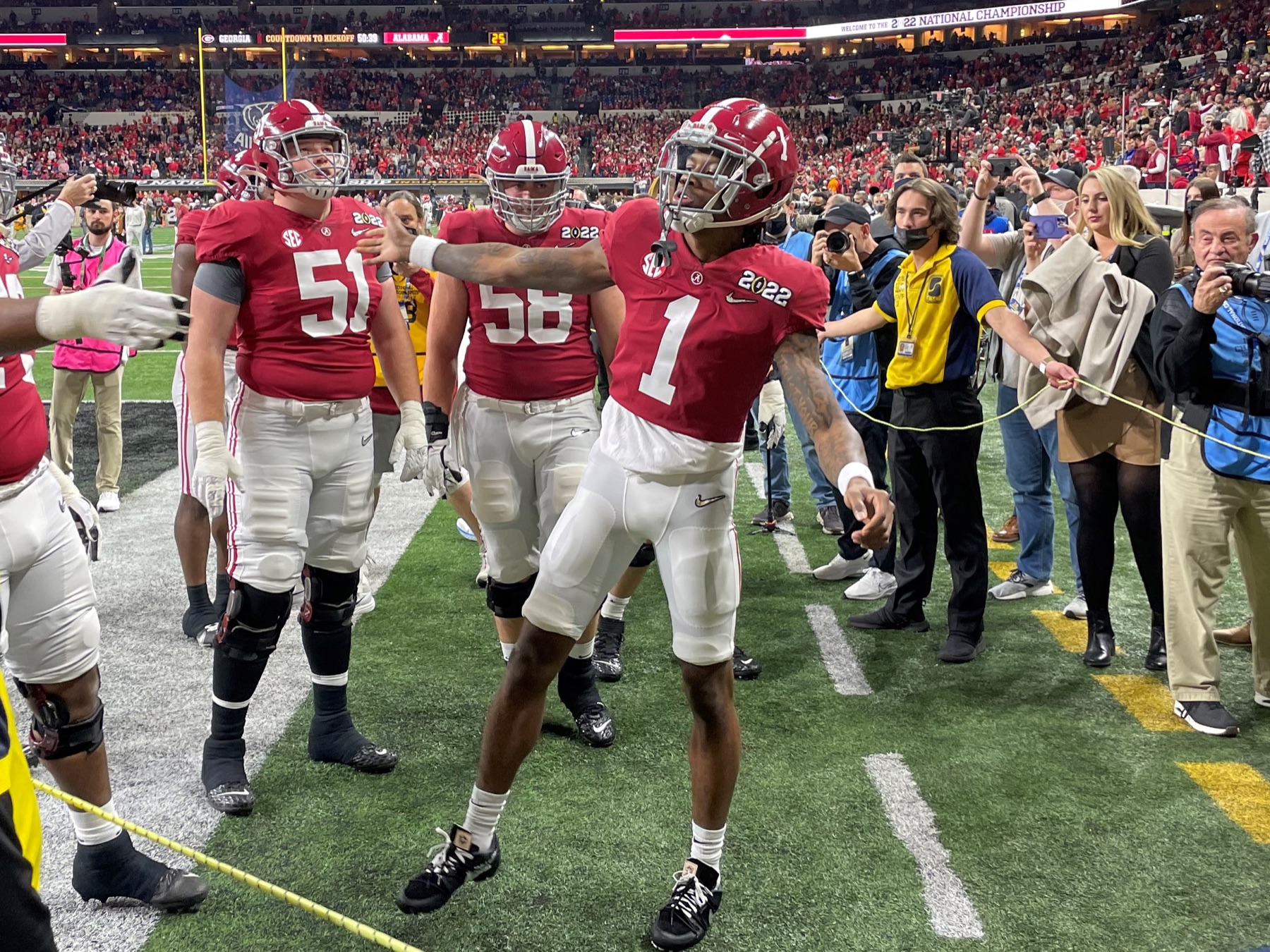
Jameson Williams saw 36 targets in his first eight games of 2025. He saw 66 in his final nine. The receiver famous for changing a game with one deep ball became a weekly part of Detroit's offense, and his fantasy production followed: 74.6 PPR points before the midpoint, 145.3 after it.
That is the case for drafting Williams in 2026. The case against him is that Amon-Ra St. Brown, Jahmyr Gibbs, and Sam LaPorta did not leave. Detroit still has more proven ways to move the ball than almost any team, and a new coordinator does not have to feed one receiver every week.
Ball Ranks has Williams 44th overall and WR21 in PPR, almost exactly aligned with his 44.2 ADP. The projection is 189.9 points, below last year's 219.9. The late-season target growth creates upside, while the efficiency is the downside risk.
Jameson Williams's ranking trend
Lower rank is better. The final point is Ball Ranks' current projection.
Full data
| Season | Rank |
|---|---|
| 2022 | #451 |
| 2023 | #263 |
| 2024 | #67 |
| 2025 | #61 |
| 2026 proj | #55 |
His ranking trajectory finally matches the talent
Williams barely played as a rookie while returning from a torn ACL, then scored 80.3 PPR points in 2023. He broke through with 1,001 receiving yards and 212.2 points in 2024, followed by career highs of 65 catches, 1,117 yards, and seven receiving touchdowns last season.
Two straight 1,000-yard years establish a much firmer floor than the old boom-or-bust label. The route detail is improving too. Detroit's August 2 camp report highlighted a third-down comeback route, not a fly pattern, as an example of his maturation. Dan Campbell said the “little things” and route definition were where Williams had grown most.
The second-half usage is the strongest evidence. Williams averaged four targets per game through eight weeks and 7.3 over the last nine. He caught 44 passes for 762 yards in that closing stretch. Even if that pace does not hold for 17 games, it changes the range of reasonable outcomes.
The drops are the part drafters should not ignore
Williams identified catching as his main offseason focus after being charged with 12 drops in 2025, the most in the league, according to DetroitLions.com. That weakness coexisted with his best season, but it also explains why a larger target share is not automatic.
A dropped deep ball can erase an entire fantasy week. More importantly, repeated drops can redirect third-down targets toward St. Brown or LaPorta. Williams does not need perfect hands to beat WR21; he needs the improvement in route variety and target volume to outweigh the lost opportunities.
Camp has supplied positive evidence. New coordinator Drew Petzing challenged Williams to play more physically at the line and catch point, and said he had responded well (DetroitLions.com). Williams briefly missed two practices with a minor shoulder issue, then returned and immediately made multiple first-team catches. He was still producing deep touchdowns in the final week of camp.
PPR is not his best format
Our board ranks Williams 44th overall in PPR but 31st in standard scoring. That 13-place spread is one of the clearest format signals in this range of the draft.
The reason is simple. Williams averaged 17.2 yards per catch last year and has scored 20- and 35-plus-yard touchdowns at a league-leading rate since 2024, according to the Lions. Standard scoring rewards those yards and touchdowns without adding a full point to every short reception caught by higher-volume receivers. In PPR, 65 catches are useful but not exceptional for a top-24 receiver.
This does not make him a bad PPR pick. It means his relative advantage grows as reception bonuses shrink. Managers in standard leagues should be willing to take him ahead of the fourth-round cluster; full-PPR managers can stay closer to ADP.
Detroit can still spread the ball away from him
Petzing says his offense will be physical, multiple, and matchup-dependent rather than built around one player. Detroit also faces one of the tougher passing schedules in our opponent-based calculation, while its rushing draw is among the softest. Those factors could pull attempts toward Gibbs and the ground game.
The counter is that Williams is no longer a specialist who needs a special package. His late-2025 volume, camp usage, and expanded route tree give Petzing more reasons to leave him on the field. He played 90.2% of Detroit's offensive snaps last season, so playing time is not the concern. Weekly target order is.
If the late-season target rate carries over, our 189.9-point projection will be light. If Detroit rotates its featured weapon by matchup and Williams remains volatile at the catch point, WR21 will prove close to fair.
Williams also fits certain roster builds better than others. His explosive weeks can win matchups, but managers who start him should pair that ceiling with receivers whose targets are less volatile. He is more difficult to rely on as the only receiver selected through four rounds.
Pay more in standard than PPR
At pick 44, Williams is appropriately priced in PPR and a value in standard formats. We would take him in the middle of the fourth round, with more aggression when lineup settings reward yardage and touchdowns over catch volume.
See Williams's live projection and history on his player profile, or compare him with every receiver on the complete rankings board.
Sources and data notes
- Ball Ranks board, season history, weekly splits, and schedule calculation: August 29, 2026 snapshot.
- Detroit Lions August 2 camp report: route development and 2025 career highs.
- Detroit Lions offseason feature: drops, offseason focus, and explosive-play history.
- Detroit Lions coordinator takeaways: Drew Petzing's offensive principles and challenge to Williams.