2026 fantasy football outlook
Kyle Pitts finally made volume boring. Draft the repeat, not the explosion.
Pitts reached TE2 on 118 targets, not a freak touchdown total. One 45-point night inflated the finish, but his every-down role makes the seventh-round discount real in PPR.

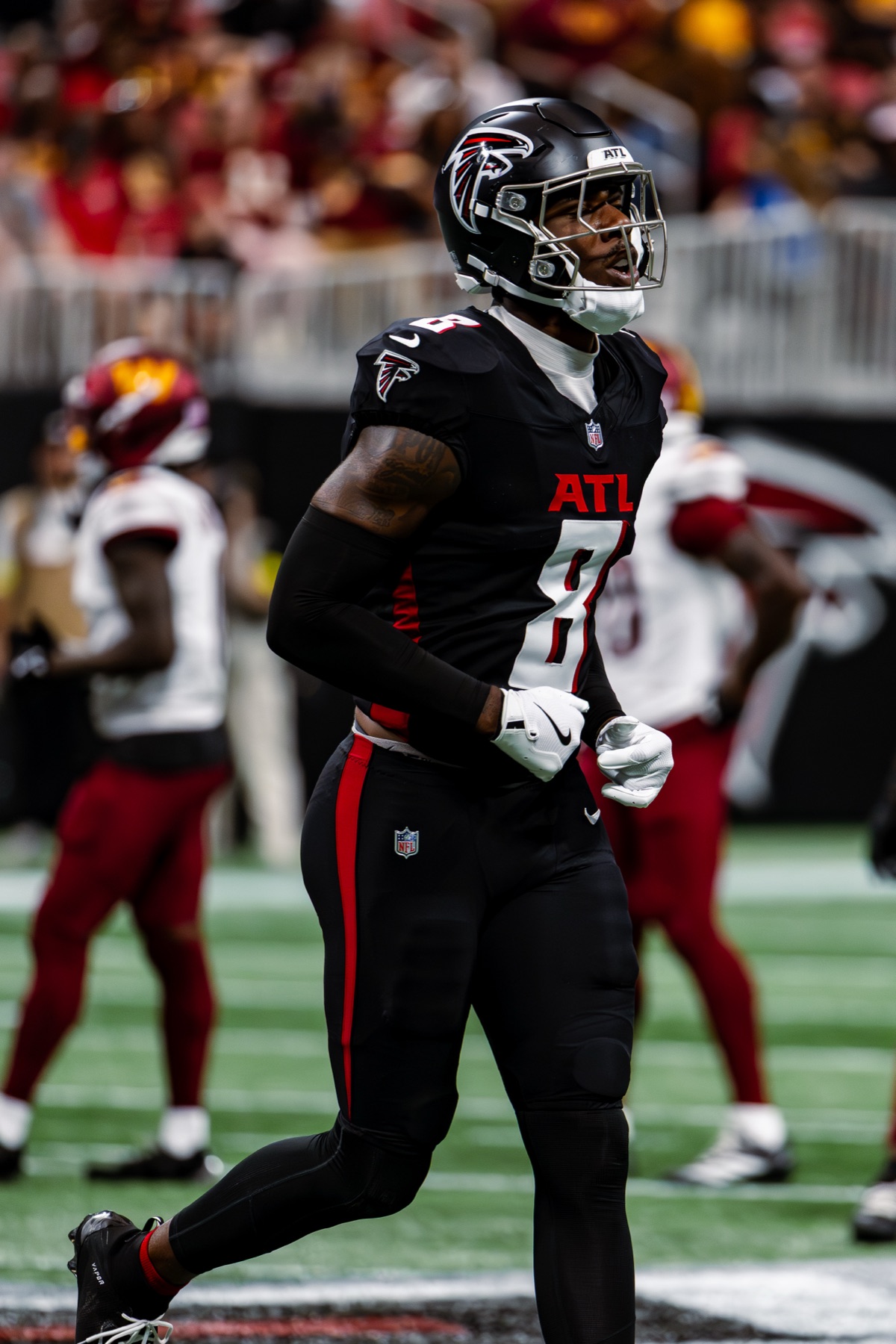
Kyle Pitts has spent most of his NFL career as an argument. Too talented to quit, too inconsistent to trust, too expensive until suddenly he was not. Every summer began with the same question: Is this finally the year?
That question expired in 2025. Pitts caught 88 passes for 928 yards and five touchdowns, scored 210.8 PPR points, and finished second among tight ends. Atlanta played him on 88% of its offensive snaps, up from 62% in 2024. The long-awaited breakout did not arrive as a projection. It happened.
In our August 29 snapshot, Pitts had a PPR ADP of 75.9 — near the start of round 7 in a 12-team draft. Ball Ranks had him at No. 65 overall and TE5, with 169.9 projected PPR points. The projection is a sizable step back from his career year, while the independent ADP figure sits eleven picks later.
Kyle Pitts's ranking trend
Lower rank is better. The final point is Ball Ranks' current projection.
Full data
| Season | Rank |
|---|---|
| 2021 | #106 |
| 2022 | #184 |
| 2023 | #161 |
| 2024 | #188 |
| 2025 | #52 |
| 2026 proj | #42 |
The breakout came from work he can keep
Pitts did not need a dozen touchdowns or a handful of broken plays to reach 210 points. He got there on 118 targets and 88 receptions. His five touchdowns were helpful, but ordinary for a starting fantasy tight end. The catches did the heavy lifting.
That distinction matters because touchdowns swing sharply from year to year. Playing time and targets are a sturdier foundation. Pitts set a career high in both snap share and receptions, and his 118 targets topped the 110 he drew as a rookie. The Falcons' official player page confirms the full 88-928-5 line and notes that he started all 17 games.
The season also repaired a trend that had been moving the wrong way. After 176.6 PPR points as a rookie, Pitts fell to 75.6 in an injury-shortened 2022 season, then 137.3 and 131.2 over the next two years. In 2025, he played more and earned more work than ever.
One Thursday night made the finish look cleaner than it was
There is a catch inside those career highs. Through Week 9, Pitts averaged 10.9 PPR points across eight games. From Week 10 onward, he averaged 13.7. That looks like a clean second-half rise until you isolate Week 15: 11 catches, 166 yards, three touchdowns, and 45.6 PPR points in one night.
That game supplied more than one-fifth of his season total. Remove it and his other eight games from Week 10 through Week 18 averaged 9.8 points. So no, we should not treat the 13.7-point closing pace as his new weekly floor.
But the outlier does not erase the underlying role. Pitts drew 64 targets over his final nine games and caught 45 of them. Even outside the explosion, he had consecutive 15-point PPR games in Weeks 13 and 14, then 18.7 in Week 16. The honest reading is less exciting than “late-season league winner” and more useful: the weekly ceiling remained unstable, while the volume became dependable.
Atlanta hired coaches who keep tight ends busy
The staff that oversaw the breakout is gone. Kevin Stefanski is Atlanta's new head coach, and Tommy Rees is the new offensive coordinator and play-caller. Scheme changes create uncertainty, but these particular résumés fit Pitts unusually well.
Rees served as Cleveland's tight ends coach and passing-game specialist in 2024 before becoming its offensive coordinator. His Falcons coaching biography notes that David Njoku led Cleveland with 64 catches and scored five touchdowns in 2024; a year later, rookie tight end Harold Fannin Jr. caught 72 passes for 731 yards and six scores. Atlanta also says Stefanski began his NFL coaching career with tight ends and has consistently featured the position in his offenses (Falcons tight end preview).
That history does not promise another 118 targets. Austin Hooper's arrival gives Atlanta another capable receiving tight end, and a heavier formation can keep Pitts on the field without making him the first read. The encouraging part is simpler: the new staff is unlikely to look at an 118-target tight end and forget the position exists.
The quarterback is a variable, not the whole bet
Pitts enters September without a settled answer at quarterback. Atlanta signed Tua Tagovailoa after Michael Penix Jr. tore his ACL in November. Penix was cleared for full-team practice on August 22, and the Falcons were still rotating both quarterbacks with the starters two days later. The competition matters, but neither outcome requires rebuilding Pitts's role from scratch.
Tagovailoa offers a career built on quick, accurate throws. Penix already helped Pitts produce much of last year's career-best line before the knee injury. The risk is less about one quarterback being unusable and more about a new starter, a new playbook, and a possible in-season change disrupting timing. It is a reason to project less than 210.8 points, not a reason to send a second-team All-Pro tight end back to the waiver-wire tier.
Full PPR is where the price becomes interesting
The format split is the clearest instruction on our board. Pitts ranks No. 65 and TE5 in PPR, No. 79 and TE6 in half PPR, then No. 101 and TE8 in standard scoring. That is a 36-pick swing from full PPR to standard.
Why? His 88 catches were worth 88 points in PPR and zero in standard. Pitts averaged 10.5 yards per catch and scored five times; his 2025 value came from repeatedly catching the ball, not from piling up long touchdowns. If your league awards a point per catch, the market is discounting his most repeatable advantage. If it awards no reception points, the same pick becomes much harder to defend.
The position matters too. Our PPR projection puts Pitts 31.5 points above the level of a tight end you could reasonably find late. You are buying a real weekly advantage without paying the third-round price attached to Trey McBride or Brock Bowers.
The new contract helps, but it does not score points
Atlanta briefly placed the franchise tag on Pitts, then signed him to a three-year contract through 2028. The agreement removes the familiar speculation about whether the Falcons actually want him. They do.
That commitment is supporting evidence, not a fantasy projection. Teams can pay a tight end for blocking, formation flexibility, and defensive attention that never reaches your lineup. The stronger reason to trust Pitts is that the investment followed 118 targets and a career-high snap share — usage Atlanta can choose to preserve under the new staff.
One spike may be hiding a repeatable floor
Ball Ranks projects 169.9 PPR points, nearly 41 below Pitts's 2025 total. That decline respects the one-game spike, the quarterback uncertainty, and the difficulty of repeating career-best volume. Consensus drafters may be making the same adjustment when they wait until pick 76.
The projection could be wrong about the size of the decline. If Rees and Stefanski keep Pitts near 110 targets, his reception floor can beat 169.9 without another three-touchdown game. The new contract, the staff's tight end history, and Pitts's age — he turns 26 in October — all leave room for 2025 to be the start of his peak rather than a one-year high.
Full PPR is the green light
In PPR, we would take Pitts around pick 65, roughly a round before his 75.9 ADP. You are not drafting the promise anymore; you are drafting a 26-year-old tight end who just finished TE2, with a model that can cut 41 points from his season and still call him a value.
In standard scoring, wait. In full PPR, stop waiting for the breakout and take the discount. See the live projection and history on Kyle Pitts's player profile, or compare him with every tight end on the complete 2026 board.
Sources and data notes
- Ball Ranks board, season totals, and weekly splits were checked August 29, 2026. The live player card may change as rankings and ADP update.
- Atlanta Falcons: Kyle Pitts player page — 2025 season and career statistics.
- Atlanta Falcons: 2026 tight end preview and Tommy Rees biography — coaching backgrounds and tight end usage.
- Atlanta Falcons: Tua Tagovailoa signing and Michael Penix Jr. clearance — August quarterback status.
- Atlanta Falcons: Kyle Pitts signs a three-year contract — contract status.