Player outlook
Ladd McConkey lost half his targets without losing his talent.
McConkey went from 8.5 targets a game to 4.75 with no reported in-season injury. Mike McDaniel can reopen the quick-game volume, but a fourth-round price assumes he will.

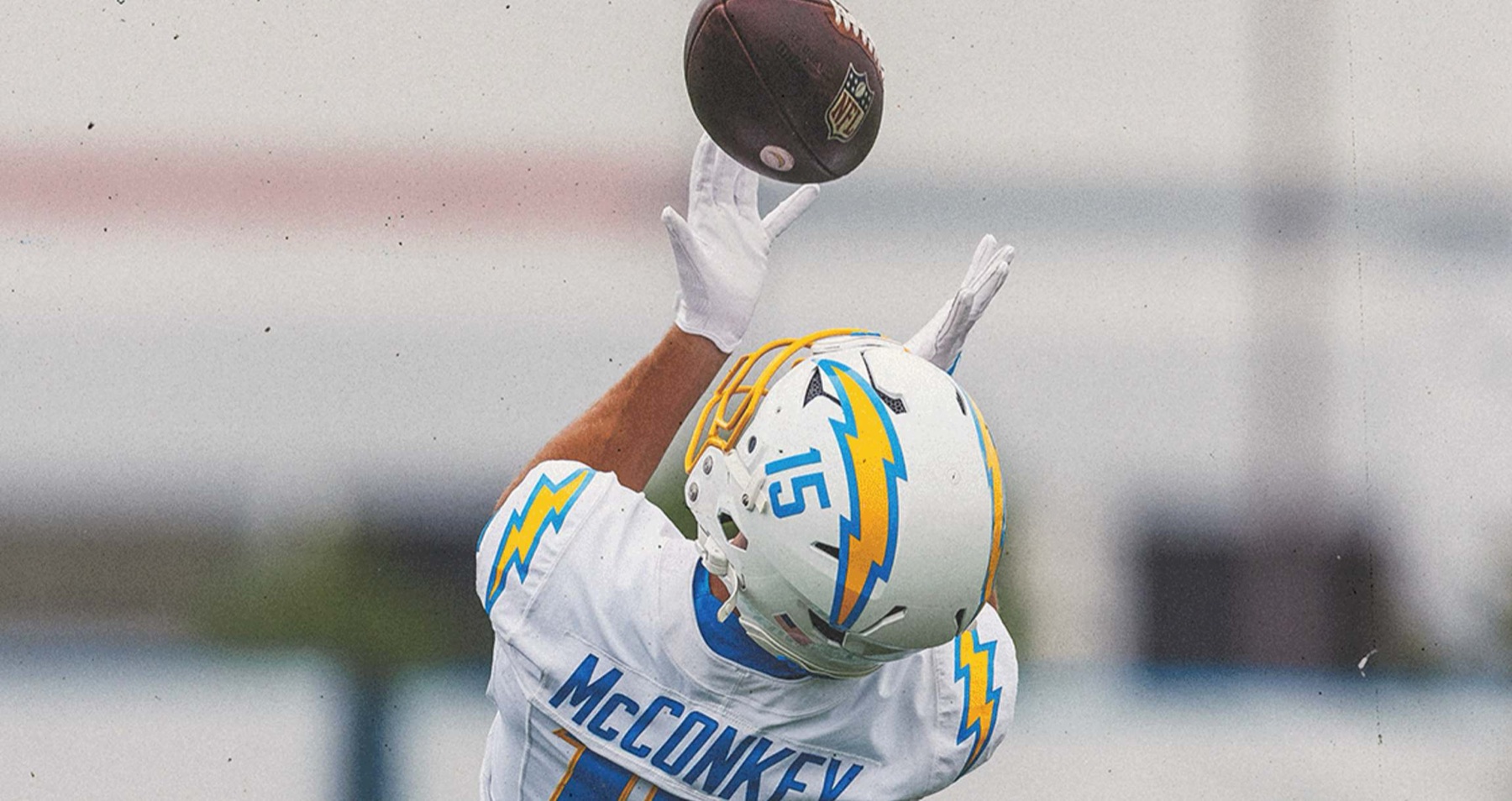
McConkey caught 43 passes for 468 yards and three touchdowns in his first eight games of 2025. Over his final eight, he caught 23 passes for 321 yards and three touchdowns. The touchdown production stayed steady. Everything else fell apart.
It was not an injury. McConkey saw 8.5 targets per game early and 4.75 per game late. Not an offense change or a shift in scheme—the Chargers' playbook stayed the same. The decline was sudden, mid-season, and specific: the league stopped throwing to him as much, and nobody has published a clear explanation for why.
That mystery is McConkey's whole 2026 outlook. He is not a broken player — his 1,149-yard rookie season proved he can produce on a good team. But his sophomore year proved the role is not guaranteed. Ball Ranks has him 41st overall and WR20 with 189 PPR points projected, using the full 2025 line. The question is whether that full line understates him or overstates him.
The decline was not a nagging injury or a usage shift
McConkey missed some offseason time with a hamstring injury this year, but he was healthy and practicing when training camp opened in August. The Chargers' own camp preview said he could have "his best season in the league," and Mike McDaniel — the new offensive coordinator, fresh from four seasons as the Dolphins' head coach — did not hedge. McDaniel emphasized quick throws and getting "the ball in the playmakers hands." McConkey's short-area quickness fits that system perfectly.
His rookie season proved he could sustain volume. 82 receptions on 112 targets in 2024 was not a flash; it was a locked-in role. Last year's first-half pace would have put him at 136 targets over 16 games. The second-half fall does not erase the first-half credibility.
Ladd McConkey's TGT trend
TGT by week, 2025.
Full data
| Week | TGT |
|---|---|
| W1 | 9 |
| W2 | 5 |
| W3 | 7 |
| W4 | 6 |
| W5 | 7 |
| W6 | 9 |
| W7 | 15 |
| W8 | 10 |
| W9 | 6 |
| W10 | 6 |
| W11 | 4 |
| W12 | — (Did not play) |
| W13 | 6 |
| W14 | 5 |
| W15 | 3 |
| W16 | 6 |
| W17 | 2 |
The new offense is designed to unlock McConkey
McDaniel's time in Miami leaned on explosive quick passing early in the season before shifting toward the run. The Chargers have similar personnel: a young, capable rushing attack and a QB in Justin Herbert who can process the quick game. McDaniel's inside/outside-zone scheme with heavy pre-snap motion is predicated on getting receivers into space and letting them work.
McConkey himself set the target: "Let's turn an 11 yards-per-catch average into 15 or 16...That stacks, you look at the end of the year and you're where you want to be." That kind of efficiency gains are the hallmark of moving from a receiver rotation into a true featured role. If McDaniel's scheme achieves that, McConkey's target volume does not need to return to 112 per season to hit his projection—even 90-95 targets with improved efficiency would deliver.
The Chargers have good health in their pass-catching group and the offensive line, two ingredients McDaniel will rely on. Their schedule is average on the pass-defense side, with opponents that allowed 220 yards per game in 2025—neither a meaningful tailwind nor a serious headwind.
Herbert is the reason the rebound does not require wishful thinking. McConkey caught 82 passes as a rookie because he could win quickly while Herbert trusted him in the middle of the field. That history gives McDaniel a proven answer, not a camp experiment. The coach can manufacture cleaner releases, but the quarterback and receiver have already shown they can turn those releases into catches.
The countercase: defenses may have found the answer first
If the second-half decline was the result of a scheme or defensive adjustment the offense could not counter, McConkey might not recover. If it was a league correction to a breakout rookie, that is correctable under a system designed to spread defenses and create space.
There is an upside: McDaniel's brand of quick-game emphasis is proven to create target volume for perimeter receivers. McConkey has the athleticism and hands for that world. If he hits 95+ targets with 65% catch rate, he could push 210 PPR points, closer to his 2024 pace.
There is a downside: if the Chargers lean on their rushing game and the midseason target drop continues to define his role, McConkey stays in the WR25-30 range with little room to grow.
Watch the alignment before the box score. If McConkey is moving across the formation and drawing the first read on third downs, five quiet targets in a run-heavy win will not be alarming. If he stays in one spot while other receivers take the motion and designed touches, the second-half demotion has survived the coordinator change. That is the distinction his fourth-round price needs to settle early.
Round four is a bet on restored targets
McConkey is worth a fourth-round selection around pick 41 in PPR, slightly ahead of his ADP. We would take him ahead of lower-ceiling receivers but not before proven workload receivers in this tier. His 2026 campaign will be a referendum on whether offensive coordinator changes can heal mid-season productivity breaks.
See McConkey's live projection and history on his player profile, or compare him with every receiver on the complete 2026 rankings board.
Sources and data notes
- Ball Ranks board, season history, weekly splits, depth chart, and schedule calculation: August 29, 2026 snapshot.
- Chargers 2026 training camp preview: McConkey's offseason hamstring injury recovery, role with new coordinator Mike McDaniel, training camp performance, and his comments on lifting his per-catch average.