Player outlook
Marvin Harrison Jr. does not need a breakout. He needs an uninterrupted season.
Harrison's output barely changed around five missed games, which makes health—not reinvention—the 2026 bet. A new quarterback and Trey McBride's target gravity keep the ceiling from being automatic.

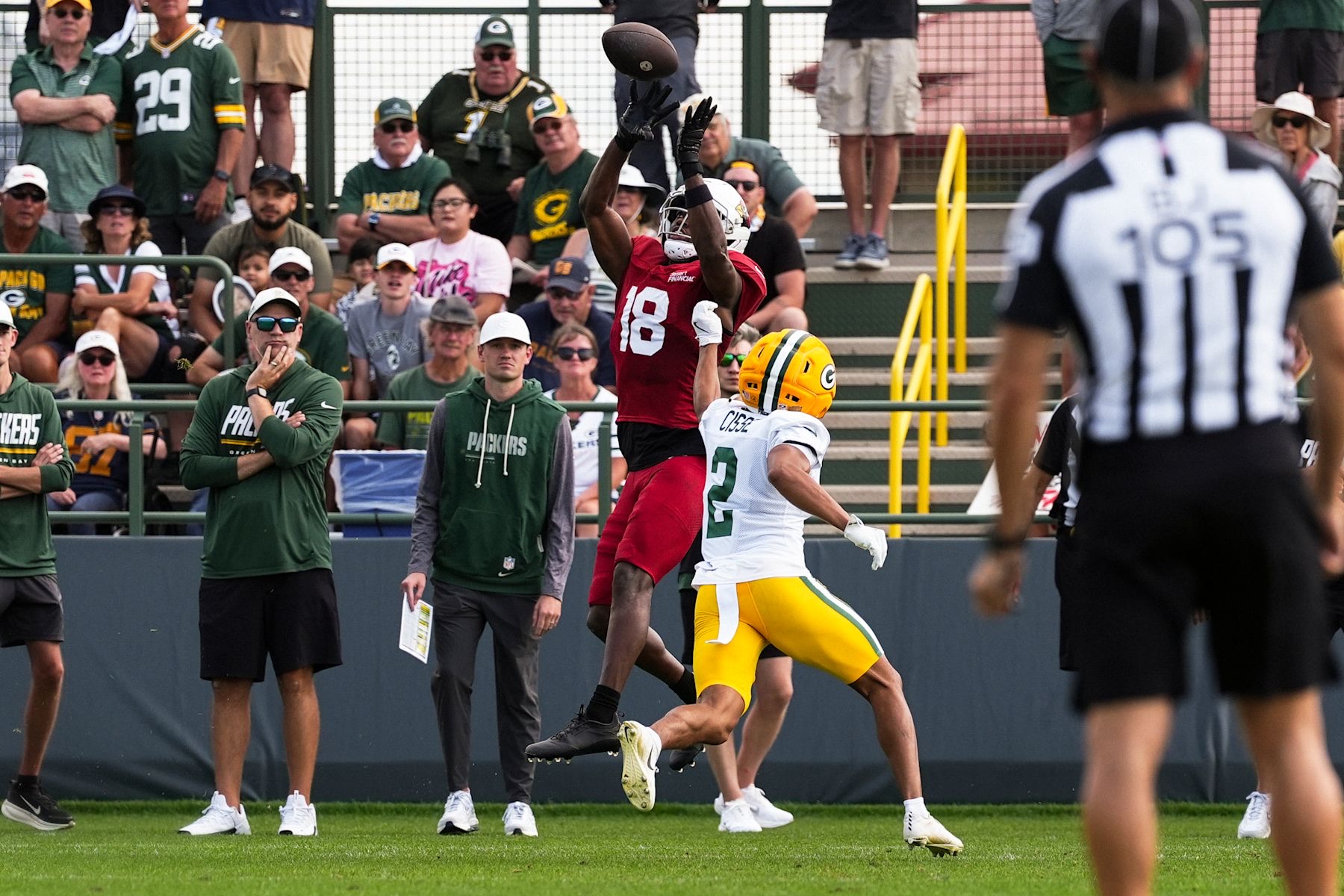
Marvin Harrison Jr.'s 2025 season lived in two halves. In his first six games, he caught 22 of 34 targets for 338 yards and 2 touchdowns — 11.3 PPR points a game. Then appendicitis, heel trouble, and a concussion cost him five games in pieces. Across the six appearances after the interruptions began, he caught 19 of 39 targets for 270 yards and 2 more scores — 10.0 PPR points a game. The gaps between the absences, not the performance in them, defined his year.
That matters for 2026. Harrison said in camp he doesn't expect last year's injuries to linger. Head coach Mike LaFleur, who called plays for the McVay-system Rams offense before taking over Arizona, endorsed him as fully cleared. The new Cardinals system emphasizes pre-snap motion, play action, and route combinations that let receivers find soft coverage — exactly the kind of structure that turns talent into volume for a player of Harrison's gifts.
Ball Ranks has Harrison 68th overall and WR34 in PPR, projecting 157.7 points. His ADP of 65.9 prices him almost exactly where we do, suggesting the market has already factored in some health risk. The real question is not whether he is priced fairly — it's whether a full 17-game season unlocks the WR1 ceiling talent scouts assigned him in the draft.
Marvin Harrison Jr.'s PPR PTS trend
PPR PTS by week, 2025.
Full data
| Week | PPR PTS |
|---|---|
| W1 | 18.1 |
| W2 | 4.7 |
| W3 | 7.4 |
| W4 | 18.6 |
| W5 | 13.8 |
| W6 | 5.2 |
| W7 | 7.8 |
| W8 | — (Did not play) |
| W9 | 22.6 |
| W10 | 14.3 |
| W11 | — (Did not play) |
| W12 | — (Did not play) |
| W13 | 12.9 |
| W14 | — (Did not play) |
| W15 | — (Did not play) |
| W16 | 2.4 |
| W17 | 0 |
The production survived every interruption
The headline of Harrison's 2025 is the five missed games. But look deeper: his per-game pace did not change before and after the injury absence. That is unusual and encouraging. Most players who return from multi-week absences show rust, role adjustments, or lingering caution from coaching staff. Harrison's target share and yards-per-reception stayed stable, suggesting both he and the offense were willing to trust his role fully.
His two-year arc matters here too. As a rookie in 2024, Harrison caught 62 passes for 885 yards and eight touchdowns — 196.5 PPR points. The talent has never been the question; 2025's counting stats collapsed because the games did. On a per-game basis, the two seasons are nearly the same receiver.
The LaFleur system was built for this
Mike LaFleur's offense at the Rams succeeded on the principle of receiver separation. Pre-snap motion, route combos that create defined looks, and play-action packages that let the QB get the ball out quickly all work best when your receiver can win in tight coverage one-on-one. Harrison's college film showed that ability repeatedly. Last year, even in a Kliff Kingsbury-led offense that was less refined, he showed flashes of it.
LaFleur's system will call on Harrison to execute those reads reliably and win contested catches at the catch point — exactly what he did in seven games in 2025. If he stays healthy, the second variable LaFleur controls is target volume: motion and formation chaos that forces the defense to assign bodies in real time. That's Harrison's lane.
The offense turned over around him. Arizona released Kyler Murray in March — he signed with Minnesota — and handed the job to Jacoby Brissett, a more deliberate passer who favors the primary read. Greg Dortch left for Detroit. The real target competition that remains is tight end Trey McBride, who commanded 169 targets last season and is the engine of this passing game. Harrison does not need to out-target McBride to pay off his price; he needs to be the clear first receiver, and the depth chart finally says he is.
The countercase is more than bad luck
Three separate injury types in one season is not a one-off. Appendicitis is random. But two heel injuries in nine weeks, plus a concussion, suggests either fragility or unlucky contact patterns. Harrison's training camp this year showed cramping in controlled settings, which the coaching staff characterized as dehydration rather than a red flag. Still, his injury history is now tracked. Fantasy managers will always price in downside for him.
A full 17-game slate at last year's 10.7-point average reaches about 181 PPR points. That would comfortably beat his injury-shortened total without requiring a leap into the position's elite. If the new offense also lifts his target quality, 200 points becomes the upside rather than the baseline. The small gap between our rank and ADP still leaves that uncertainty for drafters to judge.
Pay for health, not a leap
Take Harrison in the sixth round around his 65.9 ADP, or slightly earlier if you believe the health narrative of recovery from surgery and full camp participation. His ceiling is a top-20 receiver with elite efficiency. His floor is a capable third option in a rebuilding offense if the injury pattern repeats. The gap between those outcomes is wide, but the upside case has real air under it — a talented player in a system designed to feature him, assuming his body cooperates for 17 weeks.
See Harrison's live projection and injury history on his player profile, or explore the 2026 complete receiver board.
Sources and data notes
- Ball Ranks board, season history, weekly splits, depth chart, and schedule calculation: August 29, 2026 snapshot.
- Marvin Harrison Jr. game logs: 2024 (62 rec, 885 yards, 8 TD, 196.5 PPR) and 2025 (12 games, 73 targets, 41 catches, 608 yards, 4 TDs, 127.8 PPR), split into his first six games (11.3 PPR/game) and final six (10.0 PPR/game) from nflverse weekly data, regular season only.
- Arizona Cardinals 2026 coaching: Mike LaFleur (HC, play caller); system details from official team materials and McVay-lineage scheme history per Arizona Cardinals coaching staff.
- Harrison health status: full participation in training camp, post-surgical recovery from prior-season injuries; reported by head coach Mike LaFleur in camp interviews.
- Cardinals receiving room: Greg Dortch trade to Detroit, Kendrick Bourne arrival from San Francisco, Kyler Murray trade to Minnesota, per official NFL roster transactions.