Player outlook
Parker Washington's December touchdowns are carrying his August price.
Washington's targets moved only modestly after midseason; his touchdowns jumped from one to four. That makes Jakobi Meyers's challenge for the same short-area work more important than the depth-chart order.

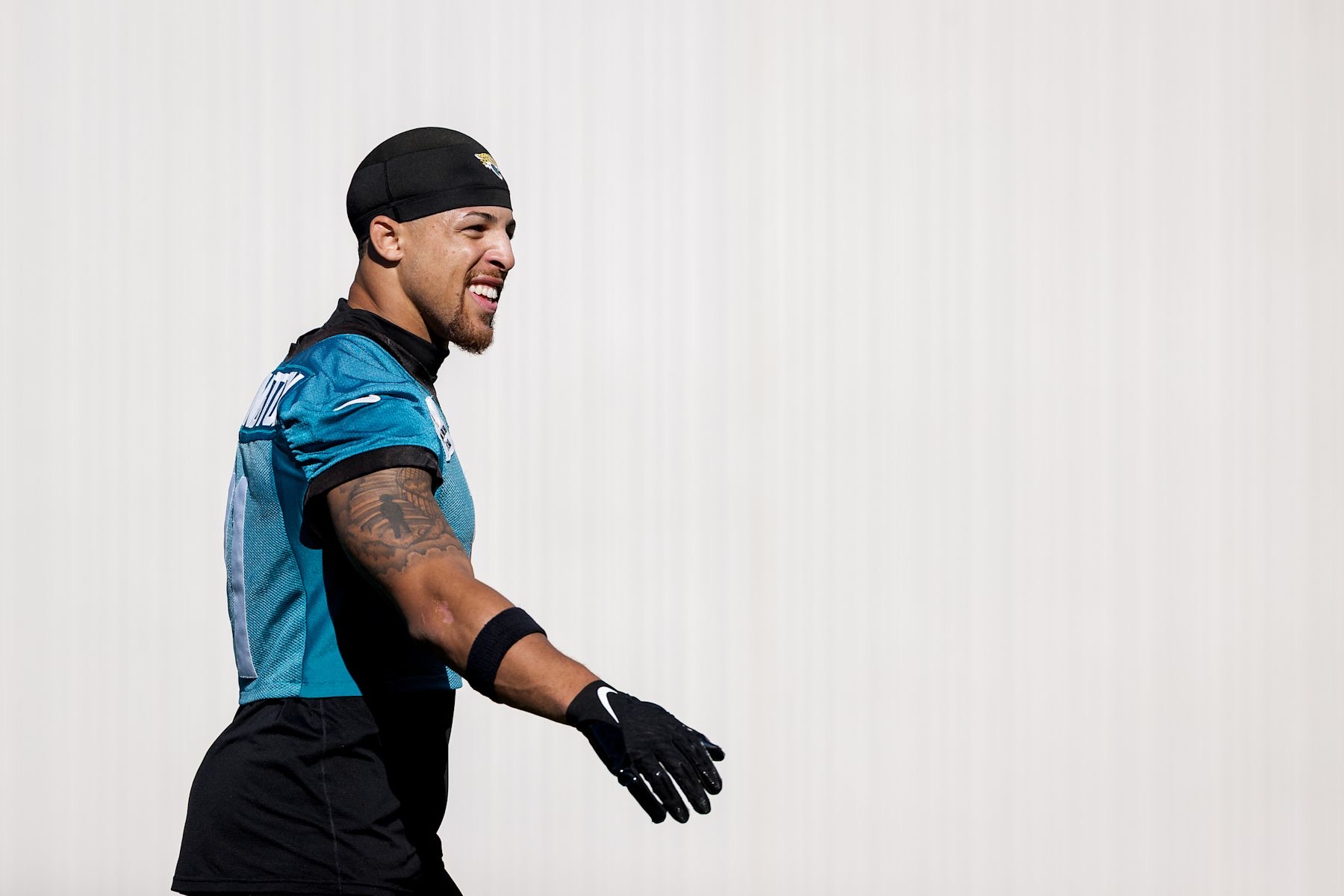
Parker Washington caught 3.6 passes per game across all 16 games he played in 2025. He caught 4.1 per game in the final eight.
The early-season version caught 25 passes across his first eight games and scored once. The late-season version caught 33 across the final eight while scoring four times. Same receiver, same offense, same quarterback — two different scoring curves.
Ball Ranks projects Washington at 142.5 PPR points in 2026, ranking him 69th overall and WR35. His ADP of 64.6 puts him as the 65th pick, roughly where value-conscious drafters add lottery-ticket receivers after taking their core. The downside case is that November and December were the outlier, not the rule.
Parker Washington's PPR PTS trend
PPR PTS by week, 2025.
Full data
| Week | PPR PTS |
|---|---|
| W1 | 0 |
| W2 | 12.6 |
| W3 | 7.4 |
| W4 | 5.9 |
| W5 | 9.6 |
| W6 | 4.9 |
| W7 | 10.2 |
| W8 | — (Did not play) |
| W9 | 17 |
| W10 | 17.9 |
| W11 | 4 |
| W12 | 18.1 |
| W13 | 3.6 |
| W14 | — (Did not play) |
| W15 | 8.3 |
| W16 | 26.5 |
| W17 | 19 |
| W18 | 19.7 |
Targets without scoring are a different receiver
Washington saw 95 targets across 16 games in 2025—an excellent total for a receiver in his role. But the touchdown placement matters as much as the catch rate does. His first eight games: 44 targets, 25 catches, 1 TD. His final eight games: 51 targets, 33 catches, 4 TD.
In the early stretch, he caught 57% of his passes for an 8.5 PPR per-game pace. In the late stretch, he caught 65% of his passes for a 14.6 PPR per-game pace. The improvement in catch rate was modest. The improvement in scoring frequency was dramatic: from one touchdown per 44 targets to one per 13.
That scoring explosion changed how defenses and gameplans approached Jacksonville's offense. A receiver who is efficient but unproductive in the red zone is a WR3. A receiver who scores twice in a game (Week 16: 6 rec, 145 yards, 1 TD; Week 18: 5 rec, 87 yards, 1 TD) becomes a waiver priority and attracts draft capital.
The question is whether the late-season version was sustainable or a sample-size artifact. Washington played all 16 games—health was never the issue. But four touchdown scores in eight games is a departure from his actual NFL track record before 2025 and from his per-opportunity profile.
Jakobi Meyers and the WR2 role
Jakobi Meyers was Jacksonville's most-targeted receiver in 2025 — 75 catches on 110 targets with an 85% snap share — and the depth chart now lists him third, behind Brian Thomas Jr. and Washington. That demotion is the organization's own verdict on Washington's late-season run.
But a veteran of Meyers' profile does not accept a bench role quietly. He works the same short and intermediate areas Washington lives in, which makes him the direct competition for the exact targets that fueled the second-half surge.
The risk is specific: if Brian Thomas Jr. solidifies the WR1 role and consumes volume, or if Meyers retains more snaps than the depth chart suggests, Washington's target share could compress. Jacksonville's loss of Tim Patrick and Dyami Brown opened volume. But Thomas's presence as the alpha also means Washington may not see a target-share increase from the 5.9 per-game he averaged in 2025.
The schedule and the late-season scoring reset
Jacksonville's 2026 opponents allowed 235 passing yards per game last season, a favorable draw. And the departures of Tim Patrick and Dyami Brown free up real targets even after Meyers takes his share.
If he sustains the four-TD-in-eight-games rate for a full season, he could reach 160–170 points. If the early-season efficiency profile is the real one, he could fall to 115–120.
Meyers can make the depth chart lie
The strongest case against Washington is not that his finish was fake. It is that Jacksonville can reward that finish and still give Meyers enough slot and third-down work to flatten both receivers. A preseason WR2 label cannot guarantee which player Trevor Lawrence trusts on third-and-six. Washington needs the late scoring to survive or the target count to grow; merely holding last year's role is not enough at pick 65.
The counter to that concern is age and trajectory. Washington earned the promotion during his third season while Meyers enters a new offense behind him. If Jacksonville uses the veteran as insurance rather than a co-starter, Washington's 95 targets can grow before the touchdowns have to regress.
Make December prove itself
Let someone else pay pick 64 for the late-season version. Ball Ranks lists him at 69, half a round later than ADP. If he slides toward pick 70, take him as a WR4 with a real weekly role. If your draft room saw those December box scores, let them reach.
See Washington's live projection and history on his player profile, or compare him with every receiver on the complete 2026 board.
Sources and data notes
- Ball Ranks board, season history, weekly splits, depth chart, and schedule calculation: August 29, 2026 snapshot.
- Parker Washington 2025 game logs and splits: nflverse player season stats (58 rec, 847 rec_yds, 5 rec_TD, 95 targets across 16 games) and weekly stats split into his first eight games (25 rec on 44 targets, 297 yards, 1 TD, 67.6 PPR) and final eight (33 rec on 51 targets, 550 yards, 4 TD, 117.1 PPR), regular season only.
- Jacksonville Jaguars 2026 depth chart and receiving corps context: nflverse depth charts (August 24, 2026) show Washington at WR2 (61.4% snap participation in 2025) behind Brian Thomas Jr. (WR1) and ahead of Jakobi Meyers (WR3). Receiver departures: Tim Patrick (52 PPR, 2025, to New York Jets) and Dyami Brown (50 PPR, 2025, to Washington).
- Trevor Lawrence 2025 passing volume (560 attempts) and 2026 continuity per official Jacksonville Jaguars coaching and roster announcements.
- Schedule difficulty: 2026 opponents' 2025 pass yards allowed averaged 235 per game (rank 30 of 32, 1 = toughest).