Player outlook
Tyler Warren earned 112 targets before Indianapolis even cleared the runway.
Michael Pittman's departure opens more work for a tight end who was already nearly every-down. Warren's late efficiency slide is the warning; full PPR turns all those short catches into the answer.

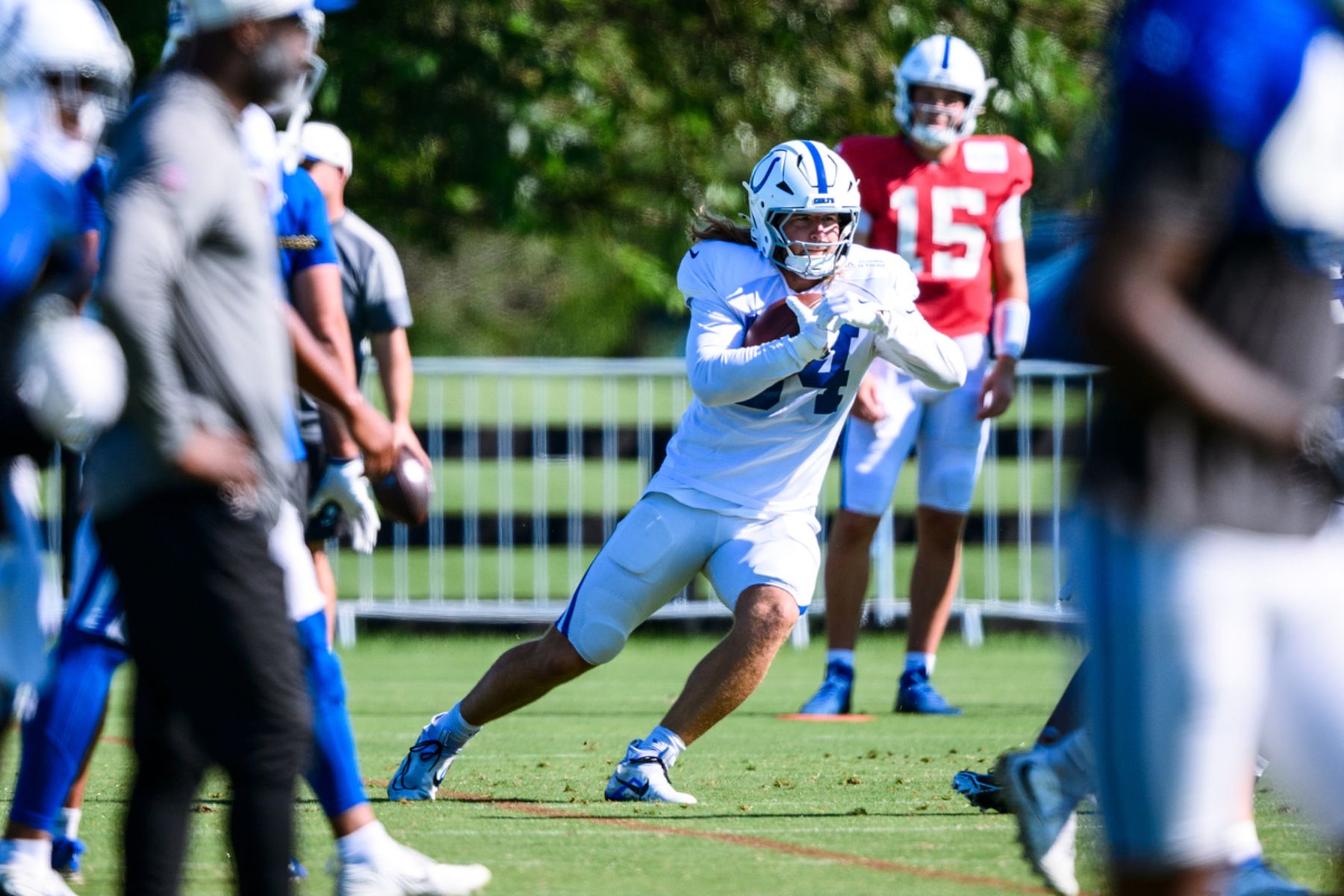
Tyler Warren received 112 targets as a rookie. Only three tight ends on the current Ball Ranks PPR board sit ahead of him, and the market still lets him reach the middle of the sixth round.
The appeal is not hard to find. Warren caught 76 passes for 817 yards and four touchdowns, added a rushing score, and played 83.8% of Indianapolis's offensive snaps. Michael Pittman Jr. is gone, while Daniel Jones returned to camp healthy and immediately resumed throwing to Warren.
Ball Ranks ranks Warren 57th overall and TE4 with 173.6 projected PPR points. His 65.1 ADP creates an eight-pick gap, one of the cleaner model-versus-market values in this part of the draft.
Tyler Warren's PPR PTS trend
PPR PTS by week, 2025.
Full data
| Week | PPR PTS |
|---|---|
| W1 | 14.9 |
| W2 | 11.9 |
| W3 | 6.8 |
| W4 | 18.3 |
| W5 | 14.4 |
| W6 | 18.3 |
| W7 | 16.9 |
| W8 | 9.3 |
| W9 | 7.6 |
| W10 | 17.9 |
| W11 | — (Did not play) |
| W12 | 9.5 |
| W13 | 11.2 |
| W14 | 3.7 |
| W15 | 4.9 |
| W16 | 6 |
| W17 | 9.3 |
| W18 | 7.6 |
The targets grew while the fantasy points fell
Warren's season split contains a useful warning. In his first eight games, he saw 50 targets, caught 37 passes for 492 yards, and scored four total touchdowns. That produced 110.8 PPR points. Over the final nine, his targets increased to 62 and his catches to 39, yet the yardage fell to 325 and he scored once, producing 77.7 points.
The late target volume is encouraging. The efficiency and touchdown decline are not. Warren averaged 13.3 yards per catch early and 8.3 late, a large change that can reflect defensive attention, route usage, quarterback play, or ordinary variance. It is a reason to project growth carefully instead of stretching the first-half pace across a full sophomore season.
The complete rookie line remains excellent for the position. Tight ends often need years to earn routes and quarterback trust. Warren entered the league as the 14th overall pick and immediately became a near-every-down player with 112 targets. His floor is built on involvement, not a handful of touchdowns.
Jones looks ready, and Warren remains central
Jones tore his Achilles in December, making quarterback health the most important external variable in Warren's outlook. The Colts said Jones would participate fully when camp opened, and Shane Steichen called his first practice performance “really good.” Jones began that session with consecutive completions to Warren (Colts.com).
The connection continued through camp. In a joint practice against New England, Jones completed three passes to Warren in a late-game drive, including a deep sideline throw that set up a touchdown (Colts.com). Practice production is not regular-season evidence, but it confirms that the injury has not prevented them from rebuilding timing.
Pittman's departure removes a veteran target competitor. Josh Downs, Alec Pierce, and Keenan Allen still make this a capable receiving group, so Warren will not absorb every available look. His rookie volume means he does not need to. Holding near 110 targets with slightly better scoring efficiency is enough for a top-five tight end season.
Scoring format changes the price
Warren is 57th overall in PPR, 64th in half-PPR, and 76th in standard on our boards. That 19-place swing is enormous for one player.
Seventy-six rookie receptions gave him a base of weekly PPR scoring that standard formats remove. He scored only five total touchdowns, so managers without reception bonuses are more dependent on a second-year scoring jump. Full-PPR managers receive value every time Indianapolis uses him as a short and intermediate outlet.
This is why a single universal ADP can mislead. At pick 65, Warren is a value in full PPR, closer to fair in half-PPR, and more expensive in standard. Draft settings matter more here than broad tight end consensus.
The Colts' passing schedule grades favorable in our opponent-based measure, and their bye is Week 13. That late bye is inconvenient near the fantasy playoffs but does not reduce Warren's season-long projection.
Defenses already showed how to flatten the volume
Warren's 112 targets can make the breakout sound inevitable. His last nine games show that volume alone does not guarantee elite production. If defenses continue forcing short catches and Indianapolis spreads red-zone work, he can repeat a strong real-football role without separating from the TE5–TE8 group.
There is also quarterback risk even after a healthy camp. Jones is returning quickly from a major injury, and a setback would change the quality of every Colts target. Warren's rookie production survived changing weekly conditions, but the ceiling is tied to a functional offense.
The draft case comes from price and position scarcity. Warren already did the difficult part: he earned an every-down role and triple-digit targets. TE4 does not require inventing a new depth-chart path.
He also changes roster construction. Taking Warren in the fifth or sixth allows managers to avoid carrying a second tight end early, because his routes and targets provide a weekly floor. In standard leagues, where that reception floor disappears, waiting longer or pairing him with a late upside option is more defensible.
PPR managers should act first
In full PPR, take Warren around pick 57, almost a round ahead of his 65.1 ADP in many rooms. Move him down as reception bonuses shrink. He is one of the few tight ends after the elite tier whose role already looks like a featured receiver's.
See Warren's live projection and history on his player profile, or compare the position on the complete 2026 board.
Sources and data notes
- Ball Ranks board, season history, weekly splits, and schedule calculation: August 29, 2026 snapshot.
- Indianapolis Colts on Daniel Jones's camp return: Jones's health and early completions to Warren.
- Indianapolis Colts joint-practice report: repeated Warren targets in the late-game period.